File:PIA16874-CobeWmapPlanckComparison-20130321.jpg


Dettagli
| Descrizione |
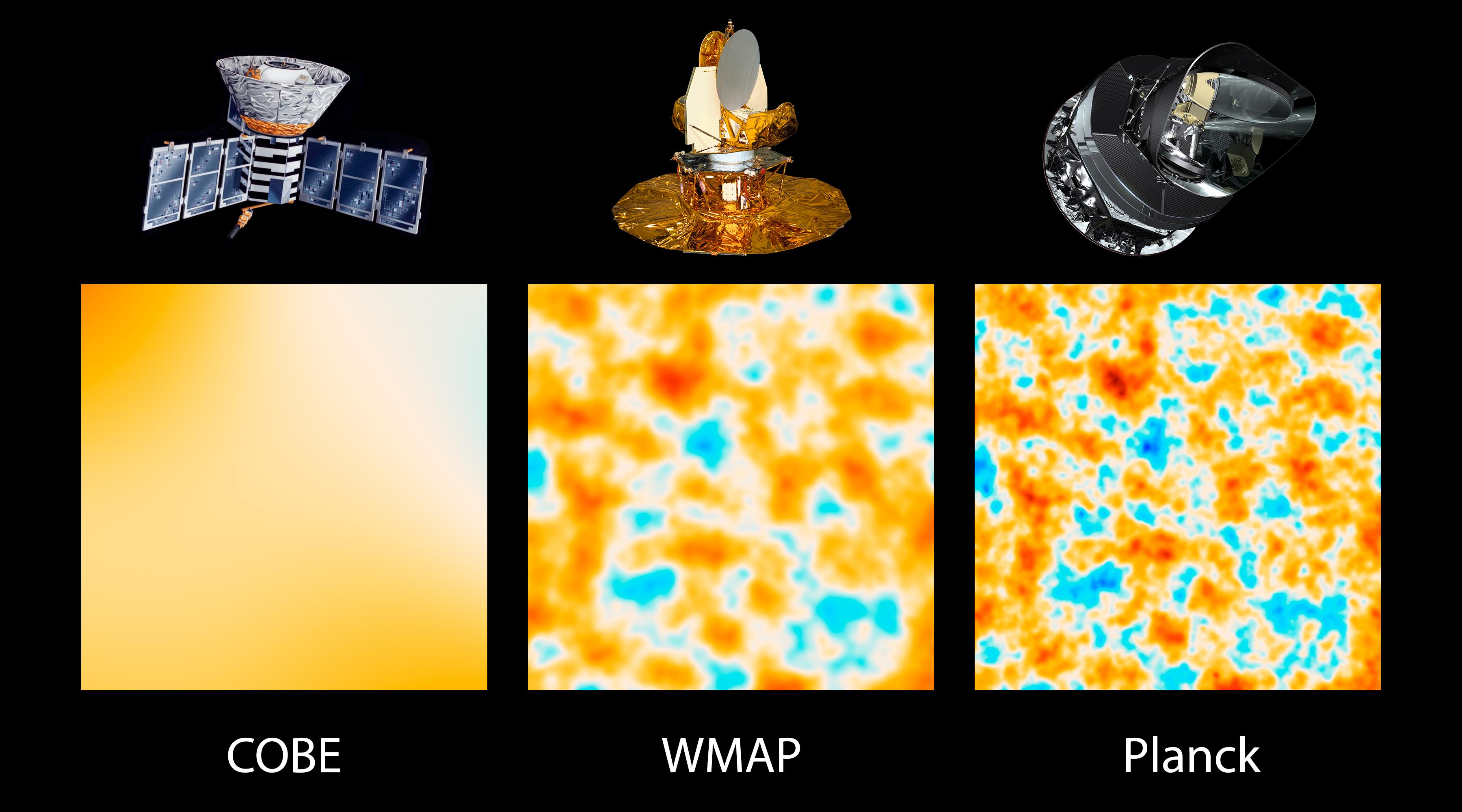
English: This graphic illustrates the evolution of satellites designed to measure ancient light leftover from the big bang that created our universe 13.8 billion years ago. Called the cosmic microwave background, this light reveals secrets of the universe's origins, fate, ingredients and more.
The three panels show 10-square-degree patches of all-sky maps created by space-based missions capable of detecting the cosmic microwave background. The first spacecraft, launched in 1989, is NASA's Cosmic Background Explorer, or COBE (left panel). Two of COBE's principal scientists earned the Nobel Prize in Physics in 2006 for the mission's evidence supporting the big bang theory, and for its demonstration that tiny variations in the ancient light reveal information about the state of the universe. These variations, called anistotropies, came into sharper focus with NASA's next-generation spacecraft, the Wilkinson Microwave Anisotropy Probe, or WMAP (middle panel). This mission, launched in 2001, found strong evidence for inflation, the very early epoch in our universe when it expanded dramatically in size, and measured basic traits of our universe better than ever before. The most advanced satellite yet of this type is Planck, a European Space Agency mission with significant NASA contributions. Planck, launched in 2009, images the sky with more than 2.5 times greater resolution than WMAP, revealing patterns in the ancient cosmic light as small as one-twelfth of a degree on the sky. Planck has created the sharpest all-sky map ever made of the universe's cosmic microwave background, precisely fine-tuning what we know about the universe. Planck is a European Space Agency mission, with significant participation from NASA. NASA's Planck Project Office is based at NASA's Jet Propulsion Laboratory, Pasadena, Calif. JPL contributed mission-enabling technology for both of Planck's science instruments. European, Canadian and U.S. Planck scientists work together to analyze the Planck data. More information is online at http://www.nasa.gov/planck, http://planck.caltech.edu and http://www.esa.int/planck. |
| Data | |
| Fonte | http://photojournal.jpl.nasa.gov/catalog/PIA16874 (direct link) |
| Autore | NASA/JPL-Caltech/ESA |

|
Questa immagine o filmato è stato catalogato dal Jet Propulsion Lab della National Aeronautics and Space Administration (NASA) degli Stati Uniti d'Americacon il Photo ID: PIA16874.Questo tag non indica lo status del copyright dell'opera ad esso associato. È quindi richiesto un normale tag di copyright. Vedi Commons:Licenze per maggiori informazioni. Altre lingue:
|
Licenza

|
Il detentore del copyright di questo file, NASA/JPL-Caltech, permette a chiunque di utilizzarlo per qualsiasi scopo, a condizione che il detentore del copyright venga riconosciuto come tale. Sono consentiti la redistribuzione, le opere derivate, la modifica, l'uso commerciale ed ogni altro uso. |
|
|
 
|
According to JPL's image use policy additional restriction is that no endorsement of any product or service by Caltech, JPL or NASA is claimed or implied.
Caltech's disclaimer: Caltech makes no representations or warranties with respect to ownership of copyrights in the images, and does not represent others who may claim to be authors or owners of copyright of any of the images, and makes no warranties as to the quality of the images. Caltech shall not be responsible for any loss or expenses resulting from the use of the images, and you release and hold Caltech harmless from all liability arising from such use. Usage on the English Wikipedia: On the English Wikipedia you can use the {{JPL Image}} template to display the copyright notice. (See w:Wikipedia:Using JPL images for details) |
Cronologia del file
Fare clic su un gruppo data/ora per vedere il file come si presentava nel momento indicato.
| Data/Ora | Miniatura | Dimensioni | Utente | Commento | |
|---|---|---|---|---|---|
| attuale | 01:48, 23 mar 2013 | | 3 600 × 2 000 (429 KB) | wikimediacommons>Nagualdesign | White background. I tried to upload this as a derivative file but Derivative FX kept hanging. (IE9 user.) |
Utilizzo del file
La seguente pagina usa questo file:
