File:NH Jupiter IR (contrast enhanced).jpg
| Descrizione |
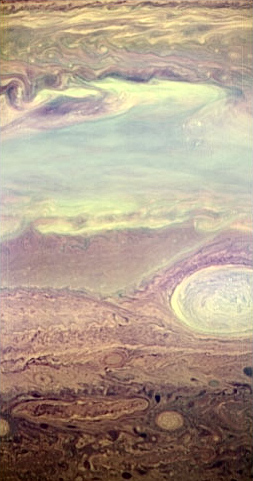
English: This image, taken with the LEISA infrared camera on the New Horizons Ralph instrument, show fine details in Jupiter's turbulent atmosphere using light that can only be seen using infrared sensors. This is a "false color" picture made by assigning infrared wavelengths to the colors red, green and blue. LEISA (Linear Etalon Imaging Spectral Array) takes images across 250 IR wavelengths in the range from 1.25 to 2.5 microns, allowing scientists to obtain an infrared spectrum at every location on Jupiter. A micron is one millionth of a meter.
This picture was taken at 05:58 UT on February 27, 2007, from a distance of 2.9 million kilometers (1.6 million miles). It is centered at 8 degrees south, 32 degrees east in Jupiter "System III" coordinates. The large oval-shaped feature is the well-known Great Red Spot. The resolution of each pixel in this image is about 175 kilometers (110 miles); Jupiter's diameter is approximately 145,000 kilometers (97,000 miles). In this image, red equals 1.28 microns, green equals 1.30 microns and blue equals 1.36 microns, a range of wavelengths that probes different altitudes in the atmosphere. This choice of wavelengths highlights Jupiter's high-altitude south polar hood of haze. This image illustrates only a small fraction of the information contained in a single LEISA scan, highlighting just one aspect of the power of infrared spectra for atmospheric studies.Español: Detalle de Júpiter a través de una cámara infrarroja LEISA, rediseñada en colores visibles y con contraste aumentado. Tomada por la nave New Horizons. |
||
| Data | |||
| Fonte | http://photojournal.jpl.nasa.gov/catalog/PIA09255 | ||
| Autore | NASA/Johns Hopkins University Applied Physics Laboratory/Southwest Research Institute | ||
| Licenza (Riusare questo file) |
PD-NASA | ||
| Altre versioni |
|
.jpg)
.jpg)

|
Questa immagine o filmato è stato catalogato dal Jet Propulsion Lab della National Aeronautics and Space Administration (NASA) degli Stati Uniti d'Americacon il Photo ID: PIA09255.Questo tag non indica lo status del copyright dell'opera ad esso associato. È quindi richiesto un normale tag di copyright. Vedi Commons:Licenze per maggiori informazioni. Altre lingue:
|
 |
Questa è una immagine ritoccata, il che significa che è stata modificata digitalmente dalla sua versione originale. Modifiche: Light contrast adjustment to bring out detail, cropped down from original file. La versione originale può essere vista qui: NH Jupiter IR (PIA09255).jpg. Le modifiche sono di Huntster.
|
Licenza

|
Questo file è nel pubblico dominio perché creato dalla NASA. La politica sul copyright della NASA afferma che «il materiale della NASA non è protetto da copyright a meno che non sia specificato altrimenti». (NASA copyright policy e JPL Image Use Policy). |  |
 |
Attenzione:
|
Cronologia del file
Fare clic su un gruppo data/ora per vedere il file come si presentava nel momento indicato.
| Data/Ora | Miniatura | Dimensioni | Utente | Commento | |
|---|---|---|---|---|---|
| attuale | 06:03, 6 gen 2014 | | 253 × 481 (84 KB) | wikimediacommons>Huntster | Far, far too much "enhancement". Using minimal contrast changes to bring out detail. |
Utilizzo del file
La seguente pagina usa questo file:
.jpg)