File originale(750 × 750 pixel, dimensione del file: 246 KB, tipo MIME: image/jpeg)
Questo file proviene da Wikimedia Commons e può essere utilizzato da altri progetti.
Di seguito viene mostrata la descrizione presente nella pagina di descrizione del file.
Wikipedia
Questa è stata una immagine in vetrina su Wikipedia in inglese (Featured pictures) dove era considerata una delle migliori immagini. Questa è una immagine in vetrina su Wikipedia in persiano (نگارههای برگزیده) dove è considerata una delle migliori immagini. Questa è una immagine in vetrina su Wikipedia in malese (Gambar pilihan) dove è considerata una delle migliori immagini.
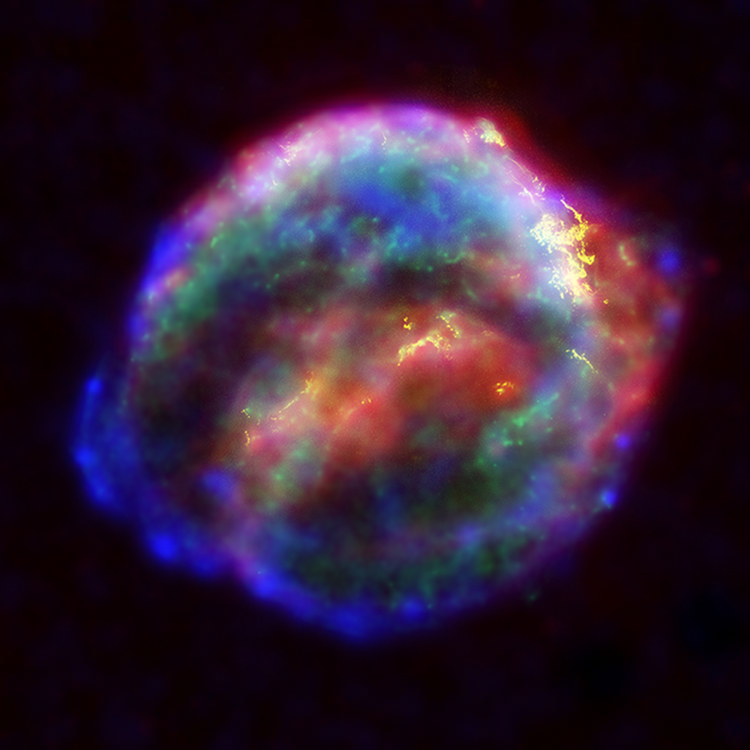
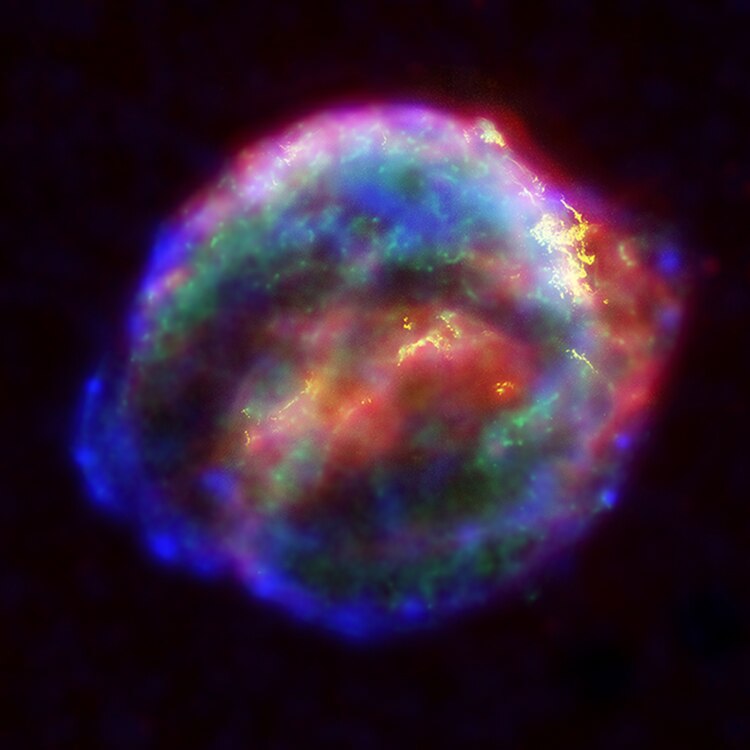
X-ray, Optical & Infrared Composite of Kepler's Supernova Remnant
"On October 9, 1604, sky watchers -- including astronomer Johannes Kepler, spotted a "new star" in the western sky, rivaling the brilliance of nearby planets. "Kepler's supernova" was the last exploding supernova seen in our Milky Way galaxy. Observers used only their eyes to study it, because the telescope had not yet been invented. Now, astronomers have utilized NASA's three Great Observatories to analyze the supernova remnant in infrared, optical and X-ray light." [1]
Color Code (Energy):
Blue: X-ray (4-6 keV), en:Chandra X-ray Observatory, The higher-energy X-rays come primarily from the regions directly behind the shock front.
Green: X-ray (0.3-1.4 keV), en:Chandra X-ray Observatory; Lower-energy X-rays mark the location of the hot remains of the exploded star.
Yellow: Optical, en:Hubble Space Telescope; The optical image reveals 10,000 degrees Celsius gas where the supernova shock wave is slamming into the densest regions of surrounding gas.
Red: Infrared, en:Spitzer space telescope; The infrared image highlights microscopic dust particles swept up and heated by the supernova shock wave.
Data
The Chandra observations were taken in June 2000, the Hubble in August 2003, and the Spitzer in August 2004. [2]
Questa è una immagine ritoccata, il che significa che è stata modificata digitalmente dalla sua versione originale. Modifiche: Minor retouching to remove some identifying text in the bottom blackspace, to aid in its use on non-English wikis..
Licenza
Public domainPublic domainfalsefalse
Questo file è nel pubblico dominio perché creato dalla NASA. La politica sul copyright della NASA afferma che «il materiale della NASA non è protetto da copyright a meno che non sia specificato altrimenti». (NASA copyright policy e JPL Image Use Policy).
Attenzione:
I loghi e gli emblemi della NASA hanno un uso ristretto per la legge USA 14 CFR 1221.
Il sito web della NASA contiene un elevato numero di immagini create da agenzie sovietiche, russe o altre non statunitensi. Queste immagini non sono nel pubblico dominio.
Tutto il materiale proveniente dalla sonda SOHO è protetto da copyright e richiede il permesso per un uso commerciale e non educativo (SOHO Copyright Notice).
Aggiungi una brevissima spiegazione di ciò che questo file rappresenta
Remnant of Kepler's Supernova SN 1604
عکسی از یک سوپرنووا
Kepler süpernovası
Johannes Kepler által 1604. október 9-én észlelt szupernóva maradványa a Hubble, Spitzer és a Chandra űrteleszkóp kompozit felvételén. A kek és zöld színek röntgentartományban, a sárga látható fényben készült, a piros pedig infravörös sugárzás.