File:Horn Antenna-in Holmdel, New Jersey.jpeg
Vai alla navigazione
Vai alla ricerca
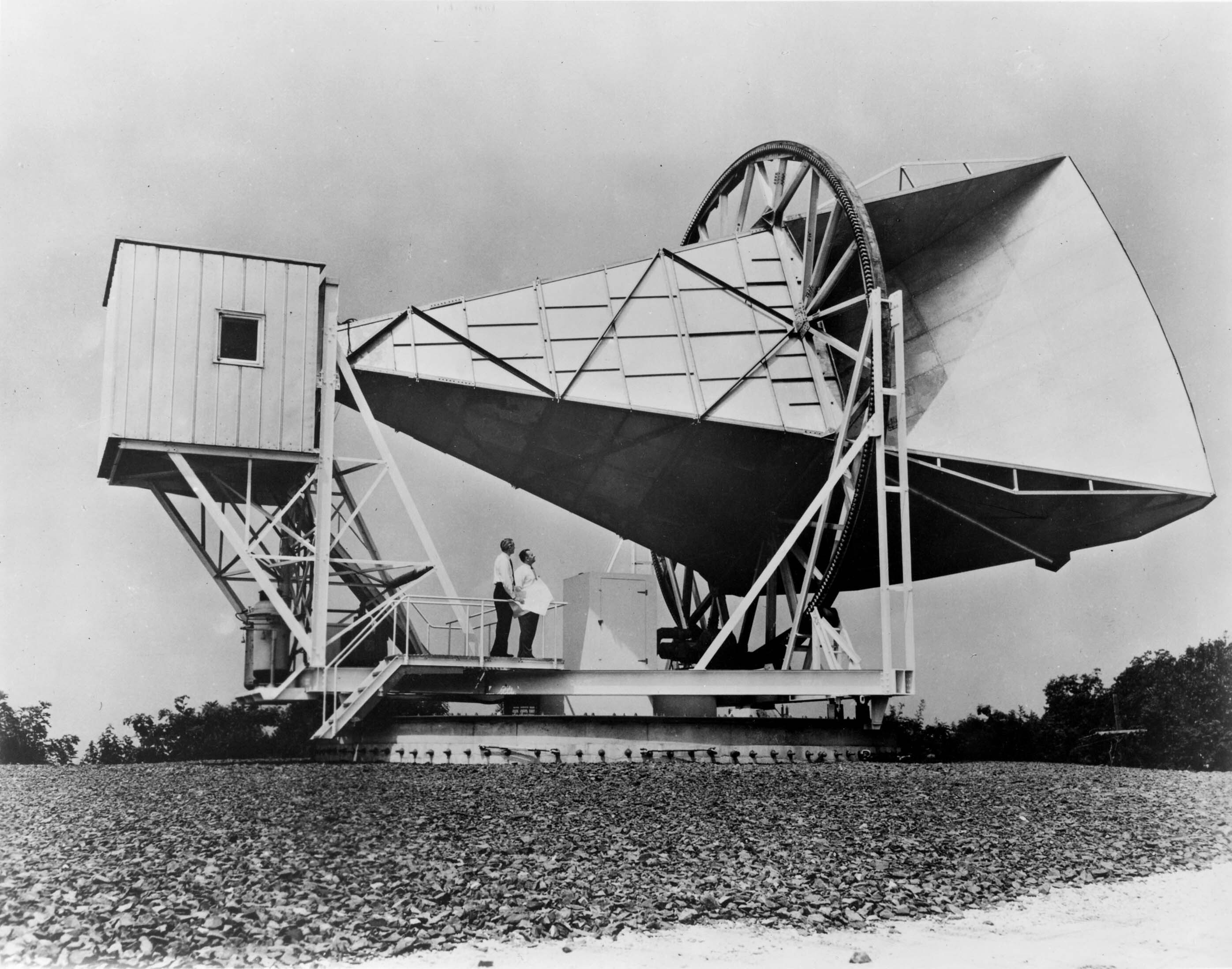
Dimensioni di questa anteprima: 762 × 599 pixel. Altre risoluzioni: 305 × 240 pixel | 610 × 480 pixel | 976 × 768 pixel | 1 280 × 1 007 pixel | 2 560 × 2 014 pixel | 2 793 × 2 197 pixel.
File originale (2 793 × 2 197 pixel, dimensione del file: 597 KB, tipo MIME: image/jpeg)

|
Questa è un'immagine di un luogo o edificio che è elencato nel National Register of Historic Places negli Stati Uniti. Il suo numero di riferimento è [https://npgallery.nps.gov/AssetDetail/NRIS/89002457
. 89002457
.] ([https://tools.wmflabs.org/hub/P649:89002457
.?site=wikidata Wikidata]). |
Dettagli
| Descrizione |
English: The 15 meter Holmdel horn antenna at Bell Telephone Laboratories in Holmdel, New Jersey was built in 1959 for pioneering work in communication satellites for the NASA ECHO I. The antenna was 50 feet in length and the entire structure weighed about 18 tons. It was composed of aluminum with a steel base. It was used to detect radio waves that bounced off Project ECHO balloon satellites. The horn was later modified to work with the Telstar Communication Satellite frequencies as a receiver for broadcast signals from the satellite. In 1964, radio astronomers Robert Wilson and Arno Penzias discovered the cosmic microwave background radiation with it, for which they were awarded the 1978 Nobel prize in physics. In 1990 the horn was dedicated to the National Park Service as a National Historic Landmark.
This type of antenna is called a Hogg or horn-reflector antenna, invented by Albert Beck and Harald Friis in 1941 and further developed by D. C. Hogg at Bell Labs in 1961. It consists of a flaring metal horn with a reflector mounted in the mouth at a 45° angle, so the antenna receives radio waves at a 90° angle to the horn axis. The reflector is a segment of a parabolic reflector, so the antenna is equivalent to a parabolic antenna fed off-axis. This type of antenna has characteristics that make it a good radio telescope: it has very broad bandwidth, the aperture efficiency can be calculated accurately, and the horn shields the antenna from electrical noise coming from angles outside the beam axis, so it picks up little thermal ground noise. |
|||||
| Data | ||||||
| Fonte |
Flickr: NASA on The Commons Original source: Archive1, Archive 2 |
|||||
| Autore | NASA | |||||
| Licenza (Riusare questo file) |
|
|||||
| Altre versioni |
|




| Posizione del soggetto |  | Posizione di questa e altre immagini su: OpenStreetMap |  |
|---|


|
Questa immagine o filmato è stato catalogato dai NASA Headquarters della National Aeronautics and Space Administration (NASA) degli Stati Uniti d'Americacon il Photo ID: GPN-2003-00013 ET Alternate ID: 62-Tels-20.Questo tag non indica lo status del copyright dell'opera ad esso associato. È quindi richiesto un normale tag di copyright. Vedi Commons:Licenze per maggiori informazioni. Altre lingue:
|
Cronologia del file
Fare clic su un gruppo data/ora per vedere il file come si presentava nel momento indicato.
| Data/Ora | Miniatura | Dimensioni | Utente | Commento | |
|---|---|---|---|---|---|
| attuale | 19:38, 26 apr 2020 | | 2 793 × 2 197 (597 KB) | wikimediacommons>Bammesk | Larger file size version (596 KB) from "NASA on The Commons" at flickr.com |
Utilizzo del file
La seguente pagina usa questo file:
