File:Center of the Milky Way Galaxy IV – Composite.jpg

Dettagli
| Descrizione |
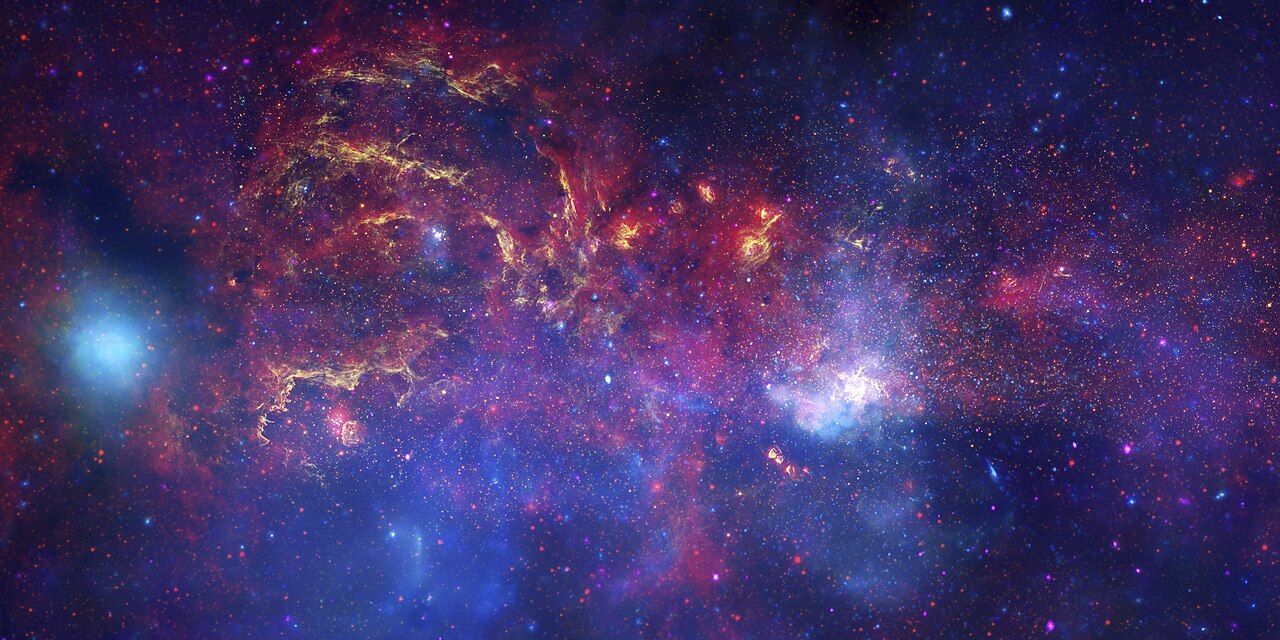
English: In celebration of the International Year of Astronomy 2009, NASA's Great Observatories -- the Hubble Space Telescope, the Spitzer Space Telescope, and the Chandra X-ray Observatory -- have produced a matched trio of images of the central region of our Milky Way galaxy. Each image shows the telescope's different wavelength view of the galactic center region, illustrating the unique science each observatory conducts.
In this spectacular image, observations using infrared light and X-ray light see through the obscuring dust and reveal the intense activity near the galactic core. Note that the center of the galaxy is located within the bright white region to the right of and just below the middle of the image. The entire image width covers about one-half a degree, about the same angular width as the full moon. Each telescope's contribution is presented in a different colour:
Español: Imagen compuesta de la región central de la Vía Láctea (por los satélites Hubble, Spitzer y Chandra).
Français : Image composite de la région centrale de la Voie lactée (par les satellites Hubble, Spitzer et Chandra).
हिन्दी: आकाशगंगा आकृति में एक सर्पिल गैलेक्सी है, जिसका एक बड़ा केंद्र है और उस से निकलती हुई कई वक्र भुजाएँ हैं। यह स्पिट्ज़र और हबल अंतरिक्ष दूरदर्शी और चंद्रा एक्स-रे वेधशाला द्वारा लिये गए चित्रों को मिलाकर बनाया गया एक विस्तृत चित्र है। चित्र के दाईं ओर और चित्र के मध्य के थोड़ा नीचे सफेद चमकता क्षेत्र केंद्र है।
Polski: Obraz centralnego obszaru Drogi Mlecznej złożony z trzech fotografii wykonanych za pomocą teleskopów kosmicznych Hubble’a, Spitzera oraz Chandra.
Italiano: Un'immagine composita della regione centrale della nostra galassia, la Via Lattea. L'immagine è stata ottenuta unendo osservazioni del Hubble Space Telescope, dello Spitzer Space Telescope e del Chandra X-ray Observatory a diverse lunghezze d'onda, permettendo di rivelare l'intensa attività vicino al nucleo galattico dietro alle scure nubi di polveri.
Português: Região central da Via Láctea. Imagem composta produzida pelos satélites Hubble, Spitzer e Chandra. |
| Data | |
| Fonte |
http://photojournal.jpl.nasa.gov/catalog/PIA12348 See also http://www.spacetelescope.org/images/opo0928a/ and http://hubblesite.org/newscenter/archive/releases/2009/28/image/a/ |
| Autore | NASA/JPL-Caltech/ESA/CXC/STScI |
| Altre versioni |
|
.jpg)
.jpg)
.jpg)

Riconoscimenti
|




|
Questa immagine è stata selezionata come Immagine del giorno in data 30 luglio 2017. La didascalia era la seguente: Italiano: Un'immagine composita della regione centrale della nostra galassia, la Via Lattea. L'immagine è stata ottenuta unendo osservazioni del Hubble Space Telescope, dello Spitzer Space Telescope e del Chandra X-ray Observatory a diverse lunghezze d'onda, permettendo di rivelare l'intensa attività vicino al nucleo galattico dietro alle scure nubi di polveri. Altre lingue:
Español: Región central de la Vía Láctea. Imagen compuesta producida por los satélites Hubble, Spitzer y Chandra. Italiano: Un'immagine composita della regione centrale della nostra galassia, la Via Lattea. L'immagine è stata ottenuta unendo osservazioni del Hubble Space Telescope, dello Spitzer Space Telescope e del Chandra X-ray Observatory a diverse lunghezze d'onda, permettendo di rivelare l'intensa attività vicino al nucleo galattico dietro alle scure nubi di polveri. Polski: Obraz centralnego obszaru Drogi Mlecznej złożony z trzech fotografii wykonanych za pomocą teleskopów kosmicznych Hubble’a, Spitzera oraz Chandra. Português: Região central da Via Láctea. Imagem composta produzida pelos satélites Hubble, Spitzer e Chandra. |
|
|
Questa immagine è stata selezionata come immagine del giorno nella Wikipedia in bengalese.
|
Licenza
- Hubble:

|
This file is in the public domain because it was created by NASA and ESA. NASA Hubble material (and ESA Hubble material prior to 2009) is copyright-free and may be freely used as in the public domain without fee, on the condition that only NASA, STScI, and/or ESA is credited as the source of the material. This license does not apply if ESA material created after 2008 or source material from other organizations is in use.
The material was created for NASA by Space Telescope Science Institute under Contract NAS5-26555, or for ESA by the Hubble European Space Agency Information Centre. Copyright statement at hubblesite.org or 2008 copyright statement at spacetelescope.org. For material created by the European Space Agency on the spacetelescope.org site since 2009, use the {{ESA-Hubble}} tag. |
- Spitzer and Chandra:
|
|
Questo file è nel pubblico dominio perché creato dalla NASA. La politica sul copyright della NASA afferma che «il materiale della NASA non è protetto da copyright a meno che non sia specificato altrimenti». (NASA copyright policy e JPL Image Use Policy). |  |
 |
Attenzione:
|
Cronologia del file
Fare clic su un gruppo data/ora per vedere il file come si presentava nel momento indicato.
| Data/Ora | Miniatura | Dimensioni | Utente | Commento | |
|---|---|---|---|---|---|
| attuale | 11:53, 3 mar 2013 | | 9 725 × 4 862 (17,36 MB) | wikimediacommons>Keraunoscopia | {{Information |Description ={{en|1=In celebration of the International Year of Astronomy 2009, NASA's Great Observatories -- the Hubble Space Telescope, the Spitzer Space Telescope, and the Chandra X-ray Observatory -- have produced a matched trio o... |
Utilizzo del file
La seguente pagina usa questo file:
